Skip to main content.
Bard
  • Bard College Logo
  • Academics sub-menuAcademics
    • Programs and Divisions
    • Structure of the Curriculum
    • Courses
    • Requirements
    • Academic Calendar
    • College Catalogue
    • Faculty
    • Bard Abroad
    • Bard NYC
    • Dual-Degree Programs
    • Bard Conservatory of Music
    • Other Study Opportunities
    • Graduate Programs
    • Early Colleges
  • Admission sub-menuAdmission
    • Applying
    • Financial Aid
    • Tuition + Payment
    • Campus Tours
    • Meet Our Students + Alumni/ae
    • For Families / Familias
    • Join Our Mailing List
    • Contact Us
  • Campus Life sub-menuCampus Life
    Living on Campus:
    • Housing + Dining
    • Campus Services + Resources
    • Campus Activities
    • New Students
    • Visiting + Transportation
    • Athletics + Recreation
    • Montgomery Place Campus
  • Civic Engagement sub-menuCivic Engagement
    Bard CCE
    • Engaged Learning
    • Student Leadership
    • Grow Your Network
    • About CCE
    • Our Partners
    • Get Involved
  • Newsroom sub-menuNews + Events
    • Newsroom
    • Events Calendar
    • Press Releases
    • Office of Communications
    • Commencement Weekend
    • Alumni/ae Reunion
    • Family and Alumni/ae Weekend
    • Fisher Center + SummerScape
    • Athletic Events
  • About Bard sub-menuAbout
      About Bard:
    • Administration
    • Bard History
    • Campus Tours
    • Mission Statement
    • Love of Learning
    • Visiting Bard
    • Employment
    • Support Bard
    • Global Higher Education Alliance
      for the 21st Century
    • Bard Abroad
    • The Bard Network
    • Inclusive Excellence
    • Sustainability
    • Title IX and Nondiscrimination
    • Inside Bard
    • Dean of the College
  • Giving
  • Search
Bard Office of Sustainability

News and Events

BOS Menu
  • About Us
  • Academics + Research
  • Inits sub-menuSustainability Initiatives
    • Energy + Climate
    • Transportation
    • Responsible Consumption
    • Food, Water + Land Use
    • Planning + Administration
    • Engagement
    • Global Goals
  • Involve sub-menuGet Involved
    • Sustainability Council
    • BardE3's
    • BardEATS
    • Bard Farm
    • Socially Responsible Investment Committee
  • News + Events
  • Home

Upcoming Events

  • 9/15
    Tuesday
    10:00 am – 2:00 pm EDT/GMT-4
    Bertelsmann Campus Center, Lobby

    Dutchess County Public Transit Outreach

    Tuesday, September 15, 2026 – Wednesday, September 16, 2026
    10:00 am – 2:00 pm EDT/GMT-4
    Bertelsmann Campus Center, Lobby

    Find out how easy it is to ride all through Dutchess County for free six days a week.  
    Download Event Program

    Contact: Alison Link
    Phone: 845-758-7625
    E-mail: [email protected]


    Go to Event Page
  • 9/23
    Wednesday
    11:00 am – 11:10 am EDT/GMT-4
    Massena Campus
    Opening Remarks, Abundant Intelligences: Jason Edward Lewis 

    Opening Remarks, Abundant Intelligences: Jason Edward Lewis 

    We hope you will join us on the land for an afternoon of symposiums and learning.

    Wednesday, September 23, 2026
    11:00 am – 11:10 am EDT/GMT-4
    Massena Campus
    Wíhanble S’a Center’s Spring Open House at the Massena Campus is a bi-yearly event for all of our Bard community that brings together collaborations with nonhuman beings through hide work, shared meals, and conversation on the land. We are an American Indian-led research center grounded in Lakota knowledge systems, where learning happens through relation, responsibility, and community. These practices form the root of our approach to developing ethical AI tools, grounding rigorous technological research in land-based knowledge. 


    Our Open House supports our college community by providing structured student training and a site for faculty engagement with Wíhanble S’a Center’s ongoing initiatives, including, but not limited to, the development of Lakota Dream Language, a neuro-AI storytelling platform that enables interactive exploration of dream narratives. 


    This year’s events center on a symposium with scholars and artists who consider present-day realities of technological entwinement within the context of Indigenous methodologies and advance new modes of ethical engagement. Fall 2026 features practitioners such as Nathan Young, Antoine Bellamare, Mikhel Proulx, Olivia Camfield, Wills Brewer, Bradley Dry, Assinijaq, and more. 

    Contact: Macaella Gray
    Phone: 512-547-8233
    E-mail: [email protected]


    Go to Event Page
  • 9/23
    Wednesday
    11:10 am – 11:30 am EDT/GMT-4
    Massena Campus
    Meaning Making and Unknowability: Suzanne Kite

    Meaning Making and Unknowability: Suzanne Kite

    We hope you will join us on the land for an afternoon of symposiums and learning.

    Wednesday, September 23, 2026
    11:10 am – 11:30 am EDT/GMT-4
    Massena Campus
    Wíhanble S’a Center’s Spring Open House at the Massena Campus is a bi-yearly event for all of our Bard community that brings together collaborations with nonhuman beings through hide work, shared meals, and conversation on the land. We are an American Indian-led research center grounded in Lakota knowledge systems, where learning happens through relation, responsibility, and community. These practices form the root of our approach to developing ethical AI tools, grounding rigorous technological research in land-based knowledge. 


    Our Open House supports our college community by providing structured student training and a site for faculty engagement with Wíhanble S’a Center’s ongoing initiatives, including, but not limited to, the development of Lakota Dream Language, a neuro-AI storytelling platform that enables interactive exploration of dream narratives. 

    This year’s events center on a symposium with scholars and artists who consider present-day realities of technological entwinement within the context of Indigenous methodologies and advance new modes of ethical engagement. Fall 2026 features practitioners such as Nathan Young, Antoine Bellamare, Mikhel Proulx, Olivia Camfield, Wills Brewer, Bradley Dry, assinijaq, and more. 

    Contact: Macaella Gray
    Phone: 512-547-8233
    E-mail: [email protected]


    Go to Event Page
  • 9/23
    Wednesday
    11:30 am – 12:15 pm EDT/GMT-4
    Massena Campus
    Transformations through Image: Olivia Camfield, Woodrow Hunt, Schon Duncan, and assinijaq

    Transformations through Image: Olivia Camfield, Woodrow Hunt, Schon Duncan, and assinijaq

    We hope you will join us on the land for an afternoon of symposiums and learning.
     

    Wednesday, September 23, 2026
    11:30 am – 12:15 pm EDT/GMT-4
    Massena Campus
    Wíhanble S’a Center’s Spring Open House at the Massena Campus is a bi-yearly event for all of our Bard community that brings together collaborations with nonhuman beings through hide work, shared meals, and conversation on the land. We are an American Indian-led research center grounded in Lakota knowledge systems, where learning happens through relation, responsibility, and community. These practices form the root of our approach to developing ethical AI tools, grounding rigorous technological research in land-based knowledge. 


    Our Open House supports our college community by providing structured student training and a site for faculty engagement with Wíhanble S’a Center’s ongoing initiatives, including, but not limited to, the development of Lakota Dream Language, a neuro-AI storytelling platform that enables interactive exploration of dream narratives. 


    This year’s events center on a symposium with scholars and artists who consider present-day realities of technological entwinement within the context of Indigenous methodologies and advance new modes of ethical engagement. Fall 2026 features practitioners such as Nathan Young, Antoine Bellamare, Mikhel Proulx, Olivia Camfield, Wills Brewer, Bradley Dry, assinijaq, and more. 

    Contact: Macaella Gray
    Phone: 512-547-8233
    E-mail: [email protected]


    Go to Event Page
  • 9/23
    Wednesday
    12:15 pm – 1:00 pm EDT/GMT-4
    Massena Campus
    Transformations through Sound: Robbie Wing & Warren Realrider 

    Transformations through Sound: Robbie Wing & Warren Realrider 

    We hope you will join us on the land for an afternoon of symposiums and learning.

    Wednesday, September 23, 2026
    12:15 pm – 1:00 pm EDT/GMT-4
    Massena Campus
    Wíhanble S’a Center’s Spring Open House at the Massena Campus is a bi-yearly event for all of our Bard community that brings together collaborations with nonhuman beings through hide work, shared meals, and conversation on the land. We are an American Indian-led research center grounded in Lakota knowledge systems, where learning happens through relation, responsibility, and community. These practices form the root of our approach to developing ethical AI tools, grounding rigorous technological research in land-based knowledge. 


    Our Open House supports our college community by providing structured student training and a site for faculty engagement with Wíhanble S’a Center’s ongoing initiatives, including, but not limited to, the development of Lakota Dream Language, a neuro-AI storytelling platform that enables interactive exploration of dream narratives. 


    This year’s events center on a symposium with scholars and artists who consider present-day realities of technological entwinement within the context of Indigenous methodologies and advance new modes of ethical engagement. Fall 2026 features practitioners such as Nathan Young, Antoine Bellamare, Mikhel Proulx, Olivia Camfield, Wills Brewer, Bradley Dry, assinijaq, and more. 

    Contact: Macaella Gray
    Phone: 512-547-8233
    E-mail: [email protected]


    Go to Event Page

Sustainability News

A Bard MBA in Sustainability student gives a presentation in front of various screens and charts

Bard’s MBA in Sustainability Featured in US News & World Report

“Our students choose a green MBA because they want a meaningful career in business."

Bard’s MBA in Sustainability Featured in US News & World Report

A Bard MBA in Sustainability student gives a presentation in front of various screens and charts
The Bard MBA in Sustainability examines the core disciplines of business through a lens of environmental and social impact.
Eban Goodstein, director of graduate programs in sustainability at Bard, was interviewed in a US News & World Report feature on green MBAs. The piece featured Bard's MBA in Sustainability as a prime example of what a green MBA can offer. “Our students choose a green MBA because they want a meaningful career in business," Goodstein said. "They don’t want to wake up every morning to just chase dollars. A sustainability MBA is one pathway to a life where, yes, you are earning money for your family, and you are also making the world a better place.”

A green MBA examines the core disciplines of business through a lens of environmental and social impact. The feature identifies a growing number of sustainability-focused MBA programs around the world, describing it as part of a global trend toward green business education. The choice, the authors conclude, is not between business or sustainability, “but whether to prepare for a future in which the two are increasingly intertwined.”

Rather than offering sustainability as an elective or concentration, Bard's MBA in Sustainability weaves it throughout the curriculum. Every course, from finance and accounting to marketing, operations, leadership, and strategy, helps students understand how business decisions create both financial and environmental outcomes.
 
Read the article in US News & World Report

Post Date: 09-03-2026
Bard Community Sciences Lab Regional Air Quality Station (RAQs) atop a roof in Kingston, NY.

Kingston Air Quality Initiative at Bard College Reports After Six Years of Monitoring

The Center for Environmental Sciences and Humanities at Bard College (CESH) is pleased to announce the release of the third annual Kingston Community Air Quality report, released by the Kingston Air Quality Initiative (KAQI) after six consecutive years of research and data collection. The report shows a slight increase in annual air pollution (as measured by particulate matter (PM2.5)) in 2025, and clear differences in street-level exposures to air quality based on location within the city. 

Kingston Air Quality Initiative at Bard College Reports After Six Years of Monitoring

Bard Community Sciences Lab Regional Air Quality Station (RAQs) atop a roof in Kingston, NY.
Bard Community Sciences Lab Regional Air Quality Station (RAQs), which tracks particulate matter in the air, atop the Andy Murphy Neighborhood Center in Kingston, NY.
The Center for Environmental Sciences and Humanities at Bard College (CESH) is pleased to announce the release of the third annual Kingston Community Air Quality report, released by the Kingston Air Quality Initiative (KAQI) after six consecutive years of research and data collection. The report shows a slight increase in annual air pollution (as measured by particulate matter (PM2.5)) in 2025, and clear differences in street-level exposures to air quality based on location within the city. 

“This unique annual report shows that, though our air still meets EPA standards annually, we did see a small upswing in air pollution last year, likely due to increased wildfire smoke plumes and woodburning in our airspaces. We also were able to detect differences in air pollution exposure over time depending on what area of Kingston people frequent,” said Eli Dueker, Director of Bard’s Center for Environmental Sciences and Humanities.  “The good news here is that KAQI is now being joined by communities across the Hudson Valley in that effort, as the Hudson Valley Community Air Network continues to grow. As a community, we are very well-poised now to take these findings and create good practices and policies to protect our access to clean air to breathe.”

KAQI began in January 2020 as a partnership between Bard’s Community Sciences Lab and the City of Kingston Conservation Advisory Council’s Air Quality Subcommittee. Since then, Kingston residents and Bard College students, staff, and faculty have facilitated both indoor and outdoor air quality monitoring projects throughout the Hudson Valley. The first air quality study of its kind in Kingston, KAQI’s monitoring efforts focus on a regional assessment of air pollution as measured from the rooftop of the Andy Murphy Neighborhood Center on Broadway in Kingston.

“We are so proud to be part of this incredible partnership for 6 years. To have this constantly building local data set and analysis really gives us a greater understanding of not only our local conditions, but the local impacts from regional influences. And even better, we are able to really see these impacts on different time scales- like short term blips from the 4th of July, to long term seasonal trends. This first hand data source provides reliable information to help guide our community both on daily decisions and on long term planning,” said Julie L. Noble, Project Manager and Sustainability Coordinator at City of Kingston

This is the second year that Hudson Valley Air Quality Coalition (HVAQ) has joined in producing the report, marking the second annual “Kingston Community Air Quality Report,” which is based on data produced through the Hudson Valley Community Air Network (HVCAN), a regional, community-powered outdoor air monitoring project. The newly released 2026 Community Air Quality Report for Kingston will be used as a model for other municipal areas where HVCAN has sensors. These annual air quality reports are intended to emulate the Drinking Water Quality reports that are issued by municipalities every year.

Additionally, the success of KAQI has led to an expansion of air quality initiatives in the Hudson Valley. HVCAN partnered this year with Ulster County to install 17 new ground‑level air quality sensors at libraries, town halls, and community centers across the county. The sensors will provide the community with real‑time information about local air pollution and offer free alerts through JustAir, a platform that notifies users when air quality becomes unhealthy and again when conditions improve. 

KAQI’s main monitoring efforts focus on a regional assessment of air pollution from fine particulate matter (PM2.5), made up of microscopic particles from burnt fuel that are released into the air from oil burners, gas burners, automobiles, cooking, grilling, and both indoor and outdoor wood burning. PM2.5 particles are so tiny, they stay suspended in the air for long periods of time, allowing them to travel long distances before depositing. When these particles are inhaled, they can enter the bloodstream through the lungs, creating or worsening health issues. There is no safe level of exposure. The World Health Organization (WHO) states that “small particulate pollution has health impacts even at very low concentrations – indeed no threshold has been identified below which no damage to health is observed.”

Residential wood burning is the largest source of PM 2.5 in Ulster County. It is responsible for more than half of emissions from all sources combined (including all types of vehicle emissions and all types of fuel source emissions). Burning wood is more polluting than burning oil, gas, or coal. After six years of comprehensive monitoring in Kingston, we continue to uncover valuable insights into our air quality and its connection to our daily activities and decisions as citizens. 

"The continued and steadily expanding presence of air quality monitors through HVCAN, Bard CSL and UAlbany has already made a difference in people's daily lives in Kingston and the Hudson Valley:  residents have access to real-time, local information that can help them know, for example, whether to avoid strenuous outdoor activity, stay indoors with windows closed and air conditioning on, or to mask up when outside.  In the past, Kingston residents had to rely on data that were collected far from where we live. This rare, community-based  air quality project provides accurate, reliable information that is allowing us to recognize the extent and nature of the pollutants here in Kingston. We know that woodsmoke is the largest overall contributor to PM 2.5 in Ulster County, and having data better positions us to advocate for policies that are more protective of our health and that of the planet," said Lorraine Farina, Director of HVAQ. 

KAQI also found that air quality measured from a rooftop is helpful as a regional air quality indicator, but that street-level air quality often has worse air quality, since PM 2.5 and other air pollutants can settle and move more slowly amongst city buildings. This phenomenon has confirmed the need for more street-level sensors in all Kingston area neighborhoods to be able to help the community make informed decisions when it comes to air quality. 

One consistent observation over the past six years is the seasonal trend of higher PM 2.5 concentrations in the winter and summer months, likely attributable to wood and fuel used for heating and recreation. Another critical factor and ongoing research subject is atmospheric inversions and their implications for ground-level air pollution in Kingston. These events occur when surface level air parcels are unable to rise up, trapping air pollution at ground level. Given Kingston's location in the Hudson Valley, where air circulation is restricted, awareness of these events is crucial for informed decision-making to mitigate air pollution. 

As we continue to research the complexities of air quality management, it's essential for Kingston residents to stay informed and engaged. By adopting sustainable practices, supporting clean energy initiatives, and advocating for policies that prioritize air quality, we can work together to create a healthier environment for all. More details about KAQI’s findings can be found at the Center for Environmental Sciences and Humanities website: https://cesh.bard.edu/csl/kaqr/

The Center for the Environment Sciences and Humanities at Bard College, through the Community Sciences Lab, has been working on a handful of air quality related projects centralized around community needs and concerns. These include:
  • Neighborhood-level air quality monitoring, through the fast-developing Hudson Valley Library Air Quality Network. Using outdoor real-time air quality monitoring devices stationed at public libraries, air quality data is free and accessible online. If any libraries are interested in joining, please reach out to [email protected].
  • In partnership with SUNY-Albany and the EPA, conducting indoor and outdoor air quality monitoring in homes with woodsmoke, mold and structurally-related air quality challenges.
  • In partnership with SUNY-Albany, tracking air pollutants such as Ozone, Black and Brown Carbon, and VOCs from HVCAN’s four Hudson Valley regional air quality stations. 
For more information or ways to get involved, please visit https://cesh.bard.edu/
Kingston Air Quality Report

Post Date: 08-25-2026
a view of a campus with students, lush grass, and mountain views

Bard College Residences Honored With Passive House Certification for Energy Efficiency

Certification from PHI is recognized worldwide as one of the most demanding and respected standards in building science.

Bard College Residences Honored With Passive House Certification for Energy Efficiency

a view of a campus with students, lush grass, and mountain views
Bard College’s North Campus Residence Complex. Photo by Bilyana Dimitrova ’99
Bard College is pleased to announce that all four of the residence buildings of its North Campus Residence Complex on the College’s Annandale campus have achieved the Passive House Certification from the Passive House Institute (PHI), an organization that sets rigorous energy-efficient building standards. Certification from PHI is recognized worldwide as one of the most demanding and respected standards in building science, requiring commitment, collaboration, and attention to detail from the owner, design team, and construction team alike. This achievement reflects Bard’s long-standing commitment to sustainability and environmental stewardship, which the College has prioritized and invested in for over 30 years.

“Bard is pleased to be an early adopter among US institutions of higher education to have been awarded the PHI certification for a residential complex of this size,” said Taun Toay, senior vice president and chief financial officer at Bard College. “In combination with our decades of leadership in the use of geothermal heat exchange systems, we are making strides to reach our pledge to be a climate neutral institution.”

The new residence halls are completely geothermal, with each building connected to a wellfield of 14-17 boreholes to provide high-efficiency heating and cooling, and are some of the most energy efficient buildings on campus. Bard College has been a leader and early adopter of geothermal and heat pump technology, with systems dating to the late 1980s. Nearly 50% of the main campus building area utilizes geothermal technology for heating and cooling, accounting for over 40 buildings on campus, and it is the default for all new construction projects. There are over 630 geothermal wells across campus, hidden beneath the surface.

Bard’s North Campus Residence Complex and the Maya Lin Performing Arts Studio, both of which opened this year, continue Bard’s legacy of pursuing sustainability best practices. Bard’s Office of Sustainability also leads multiple initiatives, including the conversion of the existing Stevenson Library to geothermal heating and cooling, a campus-wide commitment to renewable energy (including over 1MW of on-site solar capacity and developing a micro-hydro system at its Saw Kill Creek dam), and upgrading nearly all interior and exterior lighting to LED, to bring the College closer to fulfilling its pledge to achieve carbon neutrality by 2035.

Additionally, the North Campus Residence Complex, constructed in collaboration with architecture firm KPF, design studio CIVILIAN, and project management firm DBI Projects, was honored earlier this year with a 2026 DOE Better Projects Award, which recognizes innovative, industry-leading accomplishments in implementing energy, water, and waste saving measures. The North Campus dorms and the Stevenson Library received 2026 ACEC awards for engineering excellence.


Post Date: 08-05-2026

Sustainability News by Date

View Current
 
View by Year/Month
  Search:
Results 1-12 of 12

December 2024

12-17-2024
Brooke Jude Discusses Her Collaboration with Microbiologist Anne Madden to Save Amphibians
Associate Professor of Biology Brooke Jude spoke to The Scientist magazine about her collaboration with microbiologist Anne Madden, who is founder and chief scientific officer of The Microbe Institute. Their collaboration, Find Purple, Frog-Saving Microbes, is a participatory science (citizen science) and community bioart project to conserve amphibians. Their project focuses on finding and understanding the biogeography of naturally purple-pigmented bacteria that help amphibians fight off a pandemic caused by a deadly fungus that is decimating unique populations of frogs, toads, salamanders, axolotls, and newts. Jude explains how the two scientists began to work together on this project: “We started thinking that a lot of our work overlapped in interesting ways, that some of the things that [Anne] was doing in The Microbe Institute, in terms of communicating about these projects that the general public could truly understand and sink their teeth into and enjoy and be passionate about. How do you get that word out?” Part of their project involved citizen science, which encouraged science enthusiasts to sample local waterways, grow microbes, and upload data on whether they found purple-pigmented bacteria. They also received funding from National Geographic to develop educational materials about purple microbes for middle and high school students.
Read about Jude's collaboration with Madden in The Scientist
Photo: Violacein, a purple pigment produced by bacteria, which Jude discovered in a water sample from the Hudson River Valley watershed and studies in her labs. Photo by Karl Rabe
Meta: Type(s): Faculty | Subject(s): Bard Undergraduate Programs,Biology Program,Division of Science, Math, and Computing,Environmental and Urban Studies Program,Environmental/Sustainability | Institutes(s): Bard Undergraduate Programs,Center for Environmental Sciences and Humanities |

November 2024

11-26-2024
Stevenson Library Converts to Geothermal Heating and Cooling
Bard celebrates the completion of a major project to convert the Charles P. Stevenson Jr. Library’s outdated fossil fuel–fired heating system to a state-of-the-art geothermal heating and cooling system. A leader and early adopter of geothermal technologies, Bard College has ground source heat exchange systems on campus dating to the 1980s. Almost 50% of buildings on the main campus utilize geothermal technology for heating and cooling, and it is the default for all new construction projects on campus including the north campus residence buildings and the Maya Lin Performing Arts Studio.


The geothermal and HVAC renovation of the 60,000-square-foot Stevenson Library is Bard’s first conversion of an existing building from fossil fuels to geothermal. The College partnered with Brightcore as the turnkey provider of the library project, delivering a full scope of services, from the feasibility and design, drilling and ground loop installation, mechanical connections, incentive procurement, and upon completion, ongoing system performance monitoring. The library’s geothermal conversion will eliminate burning approximately 14,000 gallons of fuel oil and reduce 127 tons of carbon emissions per year. This conversion, along with Bard’s other sustainability-driven initiatives including its commitment to renewable solar and hydro energy, LED lighting, and LEEDs certifications, are significant steps toward fulfilling the College’s pledge to achieve carbon neutrality by 2035.

Further reading:
Bard College Continues Switch to Geothermal
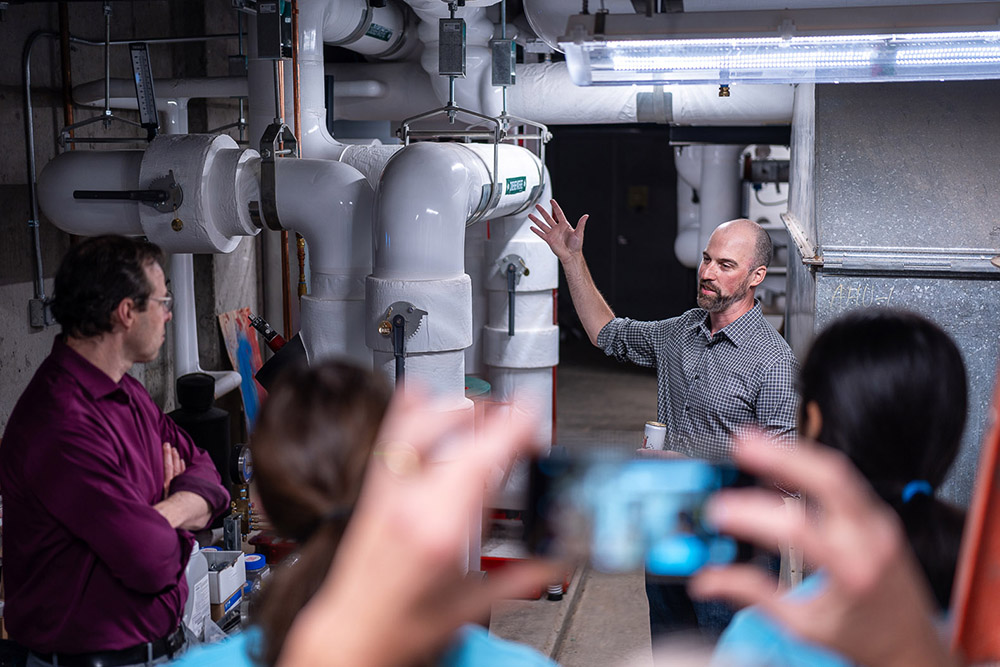
 
Stevenson Library's new geothermal and HVAC system. Photo by Joseph Nartey ’26

Photo: Ribbon-cutting for the Stevenson Library's new geothermal and HVAC system. Photo by Joseph Nartey ’26
Meta: Type(s): General | Subject(s): Environmental/Sustainability |

October 2024

10-29-2024
Film by Steve Bonds-Liptay MS ’10 <em>Valve Turners</em> Wins Climate Action Award
Valve Turners, a documentary feature film directed and produced by Steve Bonds-Liptay MS ’10, premiered and won the Climate Action Award in this year’s Climate Film Fest. Valve Turners follows a small group of activists from the Pacific Northwest as they turn the valves and halt the flow of five oil pipelines entering the United States from Canada to spotlight the climate emergency. Facing felony charges, they defend their actions as necessary in light of decades of political inaction and urgent warnings from climate scientists. The film festival called Bonds-Liptay’s feature “riveting and incisive.” Bonds-Liptay graduated from Bard’s Graduate Programs in Sustainability with a masters degree in environmental policy. 
Photo: Still from Valve Turners. Photo courtest of Climate Film Fest
Meta: Type(s): Alumni | Subject(s): Alumni/ae,Bard Graduate Programs,Bard Graduate Programs in Sustainability,Environmental/Sustainability | Institutes(s): Bard Center for Environmental Policy |

September 2024

09-30-2024
<em>Discover </em>Magazine Speaks with Biology Professor Bruce Robertson About Evolutionary Traps
Evolutionary traps are problems, most often human-created changes to the environment, which animals encounter and are not prepared for through natural selection. For example, toxic plastics that look like food or artificial lights that mimic stars in the night sky but have no navigational value. Animals lack the behavioral tools to handle them and thus make maladaptive choices that make it difficult for them to survive. Discover magazine talks to Bard Associate Professor of Biology Bruce Robertson and cites his research on some of the most concerning evolutionary traps, such as sea turtle hatchlings heading inland instead of into the water due to being confused by beachfront lights or Australian death adders poisoning themselves by preying on non-native toad species. “Traps will cycle populations toward extinction extremely rapidly,” Robertson says. “They’re like demographic black holes.” 
Read more in Discover
Photo: Associate Professor of Biology Bruce Robertson. Photo by Karl Rabe
Meta: Type(s): Faculty | Subject(s): Biology Program,Division of Science, Math, and Computing,Environmental/Sustainability,Mind, Brain, and Behavior | Institutes(s): Bard Undergraduate Programs,Center for Environmental Sciences and Humanities |
09-24-2024
A class of warmly dressed Bard College students smiling and standing outside of stone building at Stone Barns Center.
Bard Associate Professor of Biology Gabriel G. Perron and Bard Associate Professor of Chemistry Swapan S. Jain have received $46,000 from the Stone Barns Center for Food and Agriculture to study the impact of farming practices on the nutritional content and microbial diversity of fermented vegetables, which complements existing funds of $50,000 from Hudson Valley Farm Hub to study soil health. “Getting support from such an important organization not only enables us to continue our work on agroecology, but also gives us visibility at the national level,” said Gabriel G. Perron. Both Perron and Jain are also associated with the Center for Environmental Sciences and Humanities at Bard.

The Stone Barns Center funds will be used to study and document the impact of frost on the nutritional value of raw and fermented cabbage. Perron and Jain will also be investigating how frost impacts the microbial communities developing during fermentation, which affects the probiotic qualities of fermented cabbage (e.g. sauerkraut). This project will be conducted in collaboration with farmers at Stone Barns, chefs at Blue Hill at Stone Barns, and Bard College researchers Perron and Jain. Former Bard student Pearson Lau ’19, who recently published his Senior Project on the effect of chlorination on sourdough starter cultures, will also be part of the research team. Professors Perron and Jain plan to involve current Bard undergraduates in their research project. This collaboration has also made it possible to bring students from Bard and Bard NYC to visit Stone Barns and Blue Hill at Stone Barns as part of their respective classes.

“We are very excited about this wonderful collaboration with farmers and chefs in our local community. This work will help us in addressing important questions related to nutrition and the overall health of our food ecosystem,” said Swapan S. Jain.
Photo: Bard College Food Microbiology class visits the Stone Barns Center.
Meta: Type(s): Faculty | Subject(s): Biology Program,Center for Environmental Sciences and Humanities (CESH),Chemistry Program,Division of Science, Math, and Computing,Environmental/Sustainability | Institutes(s): Bard Undergraduate Programs,Center for Environmental Sciences and Humanities |

June 2024

06-18-2024
Bard College Receives $1 Million Grant from Burpee Foundation to Support the Creation of the Burpee Trial Garden at Montgomery Place Campus
Bard College has been awarded a $1 million grant to be paid over four years toward supporting the Burpee Trial Garden, which will be located at the Montgomery Place Campus. The trial garden will revitalize the fallow lawn beds at Montgomery Place that historically grew vegetables and flowers and will engage Bard students in horticultural research and hands-on scientific investigation with real-world applications. Trial gardens measure how well a specific cultivar or variety will perform in a specific area or growing condition. These trials evaluate new varieties compared to an industry standard plant from germination to maturity or from seed to harvest. Bard students will design and evaluate the cultivation of new and experimental seeds and plants and explore climate-resilient plant introductions and adaptations at the Burpee Trial Garden. Students will utilize the scientific method, plant and insect identification, pests and diseases, genetics, biology, plant breeding and propagation, and the effects of climate on plant vigor. This project will help to determine how these plants perform in our mid-Hudson River Valley growing conditions, inspire the gardening public to explore new varieties and plant combinations, and educate the professional horticulture industry and garden visitors about its findings and recommendations.

The Burpee Trial Garden at Montgomery Place campus gives Bard students the opportunity to learn how to design, plan, and execute a planting schedule, develop skills to maintain display-quality working gardens, and interpret them for visitors on a public site. This opportunity further instills a passion for plants in students, inspires their commitment to nurture their environment, and opens up knowledge of plant-related careers.

“We are thrilled that the Burpee Foundation will help Bard restore and revive the historic formal gardens at the Montgomery Place campus, since they have been left fallow for decades. The new Burpee Trial Garden will showcase various varieties of vegetables and flowers that will be open to the public and act as a unique educational opportunity for students interested in research, horticulture, agriculture, and ecology. We are very excited to begin work on enhancing and using the gardens and reporting and sharing the results. Additionally, the grant award allows Bard to show their unwavering commitment to the stewardship of the campus landscape with a dedicated arboretum director and additional gardener positions,” said Bard’s Director of Horticulture and Arboretum Amy Parrella ’99.

Comprising more than 1000 acres along the historic Hudson River, the Bard Arboretum serves as both a place for enjoyment as well as a living classroom. Working to promote environmental and social justice, the Arboretum engages with the ecological and horticultural biodiversity of the Hudson River Valley as well as the political narratives that have shaped the land.

The Burpee Foundation is committed to reducing hunger and promoting well-being through investment in horticultural and agricultural projects across the US and around the world. The Foundation was established in 2003 by George Ball ’73, when he became the sole owner of W. Atlee Burpee Company, the innovative and iconic American horticultural company whose beautiful mail order catalogues, along with Sears Roebuck’s, were the mainstays of American farms and homes during the late 19th through the mid-20th centuries. Since its inception, the Foundation has made approximately $6.5 million in gifts consistent with its mission to more than 75 charitable organizations.
Burpee
Photo: Bard students in the Montgomery Place greenhouse. Photo by China Jorrin ’86

 
Meta: Type(s): General | Subject(s): Arboretum and Horticulture,Center for Environmental Sciences and Humanities (CESH),Environmental/Sustainability,Grants | Institutes(s): Bard Undergraduate Programs |

April 2024

04-16-2024
Professor Susan Fox Rogers Leads Community Birding Walks on Cruger Island Road as Profiled in the <em>Daily Catch</em>
This spring, Susan Fox Rogers, visiting associate professor of writing, is leading Monday morning birding walks from 7 to 9 am down Cruger Island Road on Bard College’s campus. The walks, which will continue through May 27, draw an intergenerational audience and are part of a greater environmental education initiative at the Red Hook Public Library, where Rogers is the inaugural Ascienzo Naturalist in Residence. Typically, participants will spot at least four of the Hudson Valley’s most common birds: robins, chickadees, tufted titmouses, and white-breasted nuthatches. On occasion, birders will spy more unusual specimens. “On these morning walks, we have seen eagles and listened to winter wrens, spied a rare rusty blackbird with its blazing white eyes, and delighted in the wood ducks crying as they take flight,” Rogers says. Biology major William Mennerick ’25, who took up birding during the pandemic, enjoys the walks. “I love birds,” he said. “I savor the weekly evolution of the landscape over spring. It’s amazing when vegetation starts to come in and then we wait for the spring chorus of songbirds, all at once.”
Read more in the Daily Catch
Photo: Visiting Associate Professor of Writing Susan Fox Rogers (third from left) is leading Monday morning birding walks. Photo by Emily Sachar
Meta: Type(s): Faculty | Subject(s): American and Indigenous Studies Program,Division of Languages and Literature,Environmental and Urban Studies Program,Environmental/Sustainability,First-Year Seminar,Literature Program,Written Arts Program |
04-11-2024
Two students wearing hard hats smile at the camera with a wall of recycled plastic materials behind them.
Bard is pleased to be one of the first two US colleges certified as a Plastics Reduction Partner by the National Wildlife Federation (NWF). The NWF awarded bronze-level certifications to Bard College and California State Polytechnic University, Humboldt, for their efforts to reduce single-use plastics on campus. This certification acknowledges work by the Office of Sustainability, student advocates, and community partners to demonstrate significant action across four broad categories: education and awareness, behavior change, operational change, and institutional change. “Bard students are eager to defeat the monster that plastic has become,” said Laurie Husted, chief sustainability officer at Bard. “Next steps will be to fill some of the gaps we identified, including creating a Green Events Guide in collaboration with our new campus dining partner and continuing advocacy work.”
Learn More
Photo: Student volunteers with the Bard College Office of Sustainability.
Meta: Subject(s): Environmental/Sustainability |

March 2024

03-05-2024
Bard College Receives $69,300 Grant from New York State Department of Conservation Hudson River Estuary Program
Bard College has received a $69,300 grant from the New York State Department of Environmental Conservation’s (NYS DEC) Hudson River Estuary Program. Bard’s grant is part of $1.8 million in total awards recently announced by Governor Hochul for 26 projects to help communities along the Hudson River Estuary improve water quality, enhance environmental education, and advance stewardship of natural resources. Funding will support Bard’s project to develop a “River Harmful Algal Blooms Watershed Characterization and Communication Toolkit,” which includes a Watershed Characterization report and communication materials focused on harmful algal blooms (HABs) in the Walkill River, an emerging water quality issue that can impact public health.

The Bard College Community Sciences Lab will partner with the Wallkill River Watershed Alliance, Hudson River Watershed Alliance, and Riverkeeper to develop a public-facing HABs Watershed Characterization report for the Wallkill River, a Wallkill River HABs Communications Toolkit to help coordinate effective public communications about future HABs, and a broader Water Issue Communications Framework for watershed groups or municipalities across the region to guide communications planning for HABs or other emergent and emergency conditions that affect public health.

“This funding is an important investment in community-directed stewardship of Hudson River waterways, and I applaud the DEC for recognizing this,” says Bard Associate Professor of Biology and Environmental and Urban Studies M. Elias Dueker, who is also codirector of the Center for Environmental Sciences and Humanities, and head of the Community Sciences Lab. “With the increased pace of climate change, current policies regarding nutrient loading, stormwater management, and wastewater treatment simply are not keeping up with the increasing likelihood of algal blooms in our waterways as temperatures rise and precipitation regimes shift. Community scientists with a true sense of connection to these resources are a vital bridge between on-the-ground, real-time realities and the capacity for regulatory agencies to keep communities local to vulnerable waterways like the Wallkill safe. Community science is key to true climate adaptation and resilience, and I am thrilled to be part of this collaboration.”

Executive Director of Hudson River Watershed Alliance Emily Vail said: “The Hudson River Watershed Alliance is excited to be collaborating with scientists, local and regional organizations, and community members on this challenging and important issue. Harmful algal blooms can put people and pets at risk, and are an emerging threat in lakes and rivers. We’re looking forward to better understanding the latest science and communication strategies to keep people informed.”

Science Director of Riverkeeper Shannon Roback said: “Harmful algal blooms can pose health problems for both humans and animals who are exposed. As climate change progresses, we expect this risk to increase as blooms become more common. Effective public communication will be essential in reducing the harms. We are very excited that the NYS DEC Hudson River Estuary Program has funded our proposal to develop strategies to improve public outreach, communication and education around HABs, which we expect to have significant impacts to public health.”

“New York State is investing in projects that will improve resiliency and protect our natural resources both in the Hudson River Valley and across the state,” Governor Hochul said. “These 26 local grants will provide dozens of communities support to improve recreation, expand river access and education, and preserve and protect this iconic river for future generations of New Yorkers.”

Now in its 21st year, the Department of Environmental Conservation (DEC) Hudson River Estuary Grants Program implements priorities outlined in the Hudson River Estuary Action Agenda 2021-2025. To date, DEC’s Hudson River Estuary Program awarded 643 grants totaling more than $28 million. Funding for DEC’s Estuary Grants program is provided by New York State’s Environmental Protection Fund (EPF), a critical resource for environmental programs such as land acquisition, farmland protection, invasive species prevention and eradication, recreation access, water quality improvement, and environmental justice projects. Governor Hochul’s proposed 2024-25 Executive Budget maintains EPF funding at $400 million, the highest level of funding in the program’s history. 
Photo: Wallkill River showing HABs and kayaker. Photo by Emily Vail
Meta: Type(s): General | Subject(s): Biology Program,Center for Environmental Sciences and Humanities (CESH),Division of Science, Math, and Computing,Environmental and Urban Studies Program,Environmental/Sustainability,Office of Institutional Support (OIS) |

February 2024

02-28-2024
Bard College Continues Switch to Geothermal
Bard College has commenced construction of a new state-of-the-art geothermal heating and cooling project that will replace the aging, fossil fuel–fired system currently in operation in the Charles P. Stevenson Jr. Library. “Bard College has been an early adopter of geothermal, with some systems on campus dating to the late 1980s. It is the default for all new construction projects, and nearly 38% of the campus building area utilizes the technology. However, converting the rest of the existing building stock is an entirely new set of challenges, especially when infrastructure is 50 to 100 or more years old,” said Bard Energy Manager and Special Projects Coordinator Dan Smith. “We are excited to partner with Brightcore and to tap its technical and financial expertise for this crucial step on Bard’s path to achieve carbon-neutrality.” Brightcore is serving as the turnkey provider of the project, delivering a full scope of services, from the feasibility and design, drilling and ground loop installation, mechanical connections, incentive procurement, and upon completion, ongoing system performance monitoring. The Stevenson Library’s new geothermal heating and cooling system further progresses Bard’s mission-driven focus on sustainability efforts. Through its Office of Sustainability, the College has pledged to achieve carbon-neutrality by 2035 and has made significant and measurable progress in meeting that commitment. 
Full Story in BusinessWire
Read More at ABC News
Photo: Seth Goldfine Memorial Field and the Charles P. Stevenson Jr, Library at Bard College. Photo by Peter Aaron
Meta: Type(s): General | Subject(s): Campus and Facilities,Environmental/Sustainability |
02-20-2024
Bard College Institute for Writing and Thinking Hosts Conference on “Climate Change in the Classroom: Embracing New Paradigms” on April 26
Bard College’s Institute for Writing and Thinking (IWT) will host its annual April Conference and welcomes educators of all disciplines on Friday, April 26 from 9:30 am to 4:30 pm. This year’s IWT conference will focus on “Climate Change in the Classroom: Embracing New Paradigms.” The conference will be hybrid, and participants can join online or in person at Bard’s Annandale-on-Hudson, New York, campus. Participants can learn more about the conference and register here.

The rate and severity of extreme climate events can bring on a feeling of numbness and resignation rather than catalyzing responsive resilience in the classroom. How can we refocus the conversation from crisis to education and adaptation? The 2024 IWT April Conference will conduct a deep dive into layered and often contradictory pedagogies about the natural world. This day of shared writing and reflection invites participants to join together in small, interactive workshop groups in order to explore a range of written, audio, visual, and hybrid texts—on topics from manifest destiny to global climate strikes—that are creating a new ecology of education.

The day will feature a plenary conversation by two Bard colleagues on the topic of climate change in the classroom from the perspectives of the humanities and STEM, respectively. Visiting Writer in Residence Jenny Offill is the author of three novels, Last Things, Dept. of Speculation, and most recently, Weather, which was shortlisted for the Women’s Prize for Fiction. Eli Dueker is associate professor of biology and environmental and urban studies at Bard, codirector of the Center for Environmental Sciences and Humanities, and head of the Community Sciences Lab. 

Tuition fees are from $450 to $575, with Early Bird (before March 26) and Group discounts. Scholarships are available by application here. The IWT conference is Continuing Teacher and Leader Education 5.5 credit hours. Register here.
Photo: L-R: Bard faculty members Jenny Offill, visiting writer in residence, and Eli Dueker, associate professor of biology and environmental and urban studies, will hold a plenary discussion at the IWT April Conference “Climate Change in the Classroom: Embracing New Paradigms.”
Meta: Type(s): Event | Subject(s): Biology Program,Division of Languages and Literature,Division of Science, Math, and Computing,Environmental and Urban Studies Program,Environmental/Sustainability,Master of Arts in Teaching (Bard MAT),Written Arts Program | Institutes(s): Institute for Writing and Thinking |

January 2024

01-28-2024
Bard College Receives $80,379 Grant from New York State Department of Conservation to Support Removal of Invasive Plant Species on Campus
Bard College has received an $80,379 grant as part of the New York State Department of Environmental Conservation’s (NYS DEC) Invasive Species Grant Program that provides funding for aquatic and terrestrial invasive species spread prevention, early detection and rapid response, lake management planning, research, and education and outreach. Bard’s grant will support the removal and prevent the spread of invasive species from the College’s Annandale campus in the field between the Richard B. Fisher Center for the Performing Arts and Robbins House on North Campus. Invasive species including the tree of heaven (Ailanthus altissima), a rapidly growing deciduous tree native to China, and oriental bittersweet (Celastrus orbiculatus), an aggressive climbing perennial vine, are destroying the meadow by outcompeting and displacing native plant species. The NYS DEC grant will fund a project to remove the invasive woody plant material, which will be cut, chemically treated, and dug out. Then, the meadow will be replanted with a mix of native grasses and wildflowers. This meadow restoration project will begin in the summer of 2024 and is expected to take one to two years to fully complete.

“Bard is incredibly grateful to restore our beautiful meadow back to its prior glory. Its overall appearance and the quantity of ecosystem services it can offer will be immediately enhanced with this unique opportunity to reclaim a central landscape on the Bard campus,” said Bard’s Director of Horticulture and Arboretum Amy Parrella. “Meadows serve as important habitat and provide food for a number of pollinators and mammals; serve as natural reservoirs for water, capture and store carbon from the atmosphere, and help maintain biodiversity in our environment. Unfortunately, invasive plants tend to be aggressive and would eventually take over our meadow in a matter of a few years. This grant will allow Bard to proactively halt this invasion and reverse the damage that has already occurred.”

“We are committed to protecting New York’s waterways, forest lands, and agricultural crops from dangerous invasive species,” Governor Kathy Hochul said. “This funding supports projects across the state that will help prevent the spread of invasive species in New York, protecting our natural resources, economy and public health from the negative impacts of this threat.”

This grant is supported by the NYS Environmental Protection Fund (EPF), a critical resource for environmental programs such as land acquisition, farmland protection, invasive species prevention and eradication, recreation access, water quality improvement, and environmental justice projects. Governor Hochul’s proposed 2024-25 Executive Budget maintains the EPF funding at $400 million, the highest level of funding in the program’s history. 
Photo: Meadow on North Campus of Bard College.
Meta: Subject(s): Arboretum and Horticulture,Environmental/Sustainability,Grants,Office of Institutional Support (OIS) |
Results 1-12 of 12
Bard College
30 Campus Road, PO Box 5000
Annandale-on-Hudson, New York 12504-5000
Phone: 845-758-6822
Admission Email: [email protected]
Information For
Prospective Students
Current Employees
Alumni/ae 
Families

©2026 Bard College
Quick Links
Employment
Travel to Bard
Search
Support Bard
Bard IT Policies + Security
Bard Privacy Notice
Bard has a long history of creating inclusive environments for all races, creeds, ethnicities, and genders. We will continue to monitor and adhere to all Federal and New York State laws and guidance.
Like us on Facebook
Follow Us on Instagram
Threads
Bluesky
YouTube