Sustainability News by Date
Results 161-180 of 437 


October 2017
10-18-2017
Meta: Subject(s): Environmental/Sustainability | Institutes(s): Center for Civic Engagement,Montgomery Place Campus |
10-01-2017
While shooting for NBC’s The Blacklist, Boone wanted to advance her studies and passion for climate activism, so she enrolled in Bard’s MBA in Sustainability.
Meta: Type(s): Student | Subject(s): Environmental/Sustainability | Institutes(s): Bard MBA in Sustainability |
Meta: Type(s): Student | Subject(s): Environmental/Sustainability | Institutes(s): Bard MBA in Sustainability |
August 2017
08-23-2017
Meta: Subject(s): Environmental/Sustainability | Institutes(s): Bard Center for Environmental Policy |
08-22-2017
In order to maintain scenic views from the gardens and grounds of the estate, the hillside vistas must occasionally be cleared of vegetative overgrowth, a process that is complicated by steep slopes and irregular terrain, and, in recent years, the appearance of fast-growing invasive plant species that are displacing native meadow plants and need more frequent removal. The hillside has quickly become dominated by the invasive Tree of Heaven (Ailanthus altissima) and Common Reed (Phragmites australis) as well as Japanese Knotweed (Fallopia japonica). As a sustainable alternative to fossil fuel-emitting mowers, weedwhackers, and chainsaws, Bard successfully experimented in summer 2016 with contracting a local herd of goats to graze and clear the northern vista. The hillside was enclosed with temporary fencing, and the herd remained for several weeks until all vegetation was stripped.
“The goats do what they love best—eating brush, being outdoors, and standing on hills—requiring only daily fresh water, and some human assistance to topple the Ailanthus that have become too tall and thick for the goats to topple themselves,” says Bard Energy Manager Dan Smith, who comanages the project with Horticulture Supervisor and Director of the Bard Arboretum Amy Parrella. “The DEC grant will enable us to continue and expand this project and sustainably address invasive plant species and maintain these historic vistas,” added Parrella.
The $56,920 DEC grant will provide cost-share funding to host the goats for the 2017, 2018, and 2019 growing seasons, and to expand the area grazed by the goats to the southern vista, increasing the area of impact by 50 percent. The grant also includes funding for student stipends to assist with daily watering and monitoring of the herd. At the end of the third season, the vistas will be rehabilitated with stump grinding, grading, and seeding with native wildflower mix to restore the hillside to pre-invasive conditions.
Photo: Photo by Daniel Smith, 2016
Meta: Subject(s): Arboretum and Horticulture,Environmental/Sustainability,Grants,Office of Institutional Support (OIS) |
Meta: Subject(s): Arboretum and Horticulture,Environmental/Sustainability,Grants,Office of Institutional Support (OIS) |
July 2017
07-18-2017
Wide eyed, white-footed mice are the primary carriers of Lyme Disease in the Northeast. According to the Cary Institute Tick Project, the key to protecting human health is to take measures to control the white-footed mouse population.
Photo: Photo by Daniel Smith, 2016
Meta: Subject(s): Environmental/Sustainability |
Meta: Subject(s): Environmental/Sustainability |
June 2017
06-26-2017
Michael Specter explores why some deny scientific evidence, such as the safety of vaccines and GMOs, or climate change. He says denying can provide a sense of control in an unsure world.
Photo: Photo by Daniel Smith, 2016
Meta: Subject(s): Academics,Division of Science, Math, and Computing,Environmental/Sustainability |
Meta: Subject(s): Academics,Division of Science, Math, and Computing,Environmental/Sustainability |
06-01-2017
Bard professor Gidon Eshel is on a team of researchers from four American universities that says the key to reducing harmful greenhouse gases (GHG) in the short term is more likely to be found on the dinner plate than at the gas pump.
Photo: Photo by Daniel Smith, 2016
Meta: Subject(s): Division of Science, Math, and Computing,Environmental/Sustainability,Wellness | Institutes(s): Bard Center for Environmental Policy |
Meta: Subject(s): Division of Science, Math, and Computing,Environmental/Sustainability,Wellness | Institutes(s): Bard Center for Environmental Policy |
April 2017
04-04-2017
Meta: Subject(s): Division of Science, Math, and Computing,Environmental/Sustainability | Institutes(s): Bard Undergraduate Programs,Center for Environmental Sciences and Humanities |
March 2017
03-13-2017
Professor Keesing talks about her research into preventing tick-borne diseases, and the appearance of new and sometimes deadly infections in recent years.
Meta: Type(s): Faculty | Subject(s): Division of Science, Math, and Computing,Environmental/Sustainability,Wellness | Institutes(s): Bard Undergraduate Programs |
Meta: Type(s): Faculty | Subject(s): Division of Science, Math, and Computing,Environmental/Sustainability,Wellness | Institutes(s): Bard Undergraduate Programs |
03-06-2017
Bard biologist Felicia Keesing and her husband and research partner Rick Ostfeld are forecasting a tough year ahead for infections in the region, based on last year's surge in the mice population.
Meta: Type(s): Faculty | Subject(s): Division of Science, Math, and Computing,Environmental/Sustainability,Wellness | Institutes(s): Bard Undergraduate Programs |
Meta: Type(s): Faculty | Subject(s): Division of Science, Math, and Computing,Environmental/Sustainability,Wellness | Institutes(s): Bard Undergraduate Programs |
February 2017
02-26-2017
"When Gidon Eshel sits down for a meal, his plate holds a full agenda ... a cornucopia of environmental, social, and political considerations."
Meta: Type(s): Faculty | Subject(s): Division of Science, Math, and Computing,Environmental/Sustainability,Wellness | Institutes(s): Bard Undergraduate Programs |
Meta: Type(s): Faculty | Subject(s): Division of Science, Math, and Computing,Environmental/Sustainability,Wellness | Institutes(s): Bard Undergraduate Programs |
02-14-2017
The Landscape and Arboretum Program at Bard College is presenting two lectures on landscaping design this spring. On Tuesday, February 28, landscape architect Margie Ruddick will present “Wild by Design: Strategies for Creating Life-Enhancing Landscapes.” The lecture, cosponsored by the Bard Environmental and Urban Studies Program, is free and open to the public and takes place at 4:45 p.m. in Weis Cinema in the Bertelsmann Campus Center. For more information about Ruddick, visit http://www.margieruddick.com/.
On Tuesday, March 28, landscape architect and historian CeCe Haydock will present an illustrated talk, “Edith Wharton and the Villas of Rome,” presenting images of eight Roman villas described by Wharton in her book, Italian Villas and Their Gardens, first published in 1904, which remains a scholarly resource on the subject to this day. Learn about the influence of the villas on Wharton’s own houses and her novels. The lecture, presented in partnership with the Garden Conservancy, takes place at 7 p.m. in Weis Cinema in the Bertelsmann Campus Center and will be followed by a reception. The lecture is open to the public; there is a $25 registration fee ($20 for Garden Conservancy members). Complimentary tickets available for Bard students, faculty, and staff (ID required). For more information or to register, please call Jennifer Hausler at 845.424.6500, ext. 212 or e-mail [email protected].
The Landscape and Arboretum Program and the New York Botanical Garden (NYBG) also are offering noncredit continuing education classes on gardening at Bard College this spring. Open to the public, these classes feature some of the top names in the horticulture industry and cover a wide array of topics. To register, visit www.nybg.org/adulted/ or call 1-800-322-NYBG. All classes are held in room 202 of the Olin Humanities Building at Bard College in Annandale-on-Hudson, New York.
NYBG COURSES AT BARD
SPRING 2017
CONTAINER GARDENING
Container gardening know-how is in high demand. Learn how to create a container garden for your patio, terrace, or entryway that is at once functional and gorgeous—and discover techniques for ensuring that your plants thrive in all four seasons. Please bring lunch to class.
2 Saturdays, 5/6 & 5/13, 10 a.m.–2:30 p.m.
Erika Hanson | Bard | 174GAR327C
$229*/$249
GARDENING WITH NATIVE PLANTS
Learn how native plants enhance gardens and augment biodiversity. Study native herbaceous and woody plants: their identification, habitat, and culture. Hear about the significance of woodland soils, and how to promote a healthy environment to support spring ephemerals, summer perennials, shrubs, and trees.
2 Saturdays, 4/22 & 4/29, 10 a.m.–3 p.m.
Brad Roeller | Bard | 174GAR315A
$215*/$239
SPRING EPHEMERAL PAPERCUTTING
Capture the fleeting magic of woodland spring flowers with the delicate art of papercutting. You will learn basic papercutting techniques from silhouette artist Jenny Lee Fowler—whose work has been featured in Martha Stewart Living, House Beautiful, and Better Homes and Gardens—and use her one-of-a-kind patterns to create a piece of 8˝ x 10˝ art to frame and hang in your home. No previous art experience is required.
Saturday, 4/8, 10 a.m.–12 p.m.
Jenny Lee Fowler | Bard | 174CRF153A
$89*/95
POLLINATOR PAPERCUTTINGS
Use the ancient tradition of papercutting to “draw in silhouette” and celebrate the role of pollinators—birds, bats, beetles, bees, and butterflies—and their connections with plants. You will choose a pollinator and plant pairing to inspire your own original design that you will turn into a work of art with the help of Hudson-based paper artist Jenny Lee Fowler. No previous art experience is required.
Saturday, 4/15, 10 a.m.–12 p.m.
Jenny Lee Fowler | Bard | 174CRF165A
$89*/$95
*Reduced price for members of the New York Botanical Garden; Friends of the Landscape and Arboretum Program; and Bard faculty, staff, and students.
Meta: Subject(s): Arboretum and Horticulture,Education,Environmental/Sustainability |
On Tuesday, March 28, landscape architect and historian CeCe Haydock will present an illustrated talk, “Edith Wharton and the Villas of Rome,” presenting images of eight Roman villas described by Wharton in her book, Italian Villas and Their Gardens, first published in 1904, which remains a scholarly resource on the subject to this day. Learn about the influence of the villas on Wharton’s own houses and her novels. The lecture, presented in partnership with the Garden Conservancy, takes place at 7 p.m. in Weis Cinema in the Bertelsmann Campus Center and will be followed by a reception. The lecture is open to the public; there is a $25 registration fee ($20 for Garden Conservancy members). Complimentary tickets available for Bard students, faculty, and staff (ID required). For more information or to register, please call Jennifer Hausler at 845.424.6500, ext. 212 or e-mail [email protected].
The Landscape and Arboretum Program and the New York Botanical Garden (NYBG) also are offering noncredit continuing education classes on gardening at Bard College this spring. Open to the public, these classes feature some of the top names in the horticulture industry and cover a wide array of topics. To register, visit www.nybg.org/adulted/ or call 1-800-322-NYBG. All classes are held in room 202 of the Olin Humanities Building at Bard College in Annandale-on-Hudson, New York.
NYBG COURSES AT BARD
SPRING 2017
CONTAINER GARDENING
Container gardening know-how is in high demand. Learn how to create a container garden for your patio, terrace, or entryway that is at once functional and gorgeous—and discover techniques for ensuring that your plants thrive in all four seasons. Please bring lunch to class.
2 Saturdays, 5/6 & 5/13, 10 a.m.–2:30 p.m.
Erika Hanson | Bard | 174GAR327C
$229*/$249
GARDENING WITH NATIVE PLANTS
Learn how native plants enhance gardens and augment biodiversity. Study native herbaceous and woody plants: their identification, habitat, and culture. Hear about the significance of woodland soils, and how to promote a healthy environment to support spring ephemerals, summer perennials, shrubs, and trees.
2 Saturdays, 4/22 & 4/29, 10 a.m.–3 p.m.
Brad Roeller | Bard | 174GAR315A
$215*/$239
SPRING EPHEMERAL PAPERCUTTING
Capture the fleeting magic of woodland spring flowers with the delicate art of papercutting. You will learn basic papercutting techniques from silhouette artist Jenny Lee Fowler—whose work has been featured in Martha Stewart Living, House Beautiful, and Better Homes and Gardens—and use her one-of-a-kind patterns to create a piece of 8˝ x 10˝ art to frame and hang in your home. No previous art experience is required.
Saturday, 4/8, 10 a.m.–12 p.m.
Jenny Lee Fowler | Bard | 174CRF153A
$89*/95
POLLINATOR PAPERCUTTINGS
Use the ancient tradition of papercutting to “draw in silhouette” and celebrate the role of pollinators—birds, bats, beetles, bees, and butterflies—and their connections with plants. You will choose a pollinator and plant pairing to inspire your own original design that you will turn into a work of art with the help of Hudson-based paper artist Jenny Lee Fowler. No previous art experience is required.
Saturday, 4/15, 10 a.m.–12 p.m.
Jenny Lee Fowler | Bard | 174CRF165A
$89*/$95
*Reduced price for members of the New York Botanical Garden; Friends of the Landscape and Arboretum Program; and Bard faculty, staff, and students.
Meta: Subject(s): Arboretum and Horticulture,Education,Environmental/Sustainability |
02-09-2017
Historian and Rachel Carson biographer Mark Lytle is a significant voice in a new documentary on the famous conservationist and author of the highly influential book Silent Spring.
Meta: Type(s): Faculty | Subject(s): Division of Social Studies,Environmental/Sustainability | Institutes(s): Bard Undergraduate Programs |
Meta: Type(s): Faculty | Subject(s): Division of Social Studies,Environmental/Sustainability | Institutes(s): Bard Undergraduate Programs |
January 2017
01-17-2017
Bard students worked at more than 30 sites, ranging from Historic Hudson River Sloop Clearwater and Red Hook Public Library to Planned Parenthood. Students also participated in an E-Waste project where the Town and Villages of Red Hook and Tivoli, together with the Red Hook Conservation Advisory Council and Bard Office of Sustainability, hosted an electronic waste collection day for their residents.
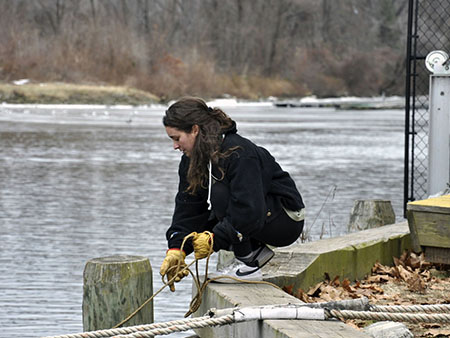
Volunteering on the Hudson River Sloop Clearwater. Photo by Joe Fitzgerald
Members of Bard's student-led TLS project Brothers at Bard also led a science project with Kingston High School students for elementary school students from nearby Rhinebeck, New York. The activities ranged from dissecting owl pellets to discovering and identifying bones, as well as testing sound physics and constructing lava lamps. Volunteers and engagement fellows from Bard's Center for Civic Engagement prepared lessons in conjunction with other student-led science activities taking place throughout the month in local school districts.
Read more about the day’s events on the Martin Luther King Jr. Day of Engagement blog.

Writers and editors with Oblivion Magazine lead a workshop on coded language in the news. Photo by C. Azemar
Photo: Students work on landscaping at Bard's Montgomery Place Campus Credit: Photo by Joy Al-Nemri
Meta: Type(s): Event | Subject(s): Education,Environmental/Sustainability,Student,Wellness | Institutes(s): Bard Undergraduate Programs |
Meta: Type(s): Event | Subject(s): Education,Environmental/Sustainability,Student,Wellness | Institutes(s): Bard Undergraduate Programs |
01-06-2017
Bard professor, biologist Felicia Keesing on why these little marsupials are the unsung heroes of the fight against Lyme and other tick-borne illnesses.
Photo: Students work on landscaping at Bard's Montgomery Place Campus Credit: Photo by Joy Al-Nemri
Meta: Type(s): Faculty | Subject(s): Division of Science, Math, and Computing,Environmental/Sustainability,Wellness | Institutes(s): Bard Undergraduate Programs |
Meta: Type(s): Faculty | Subject(s): Division of Science, Math, and Computing,Environmental/Sustainability,Wellness | Institutes(s): Bard Undergraduate Programs |
01-02-2017
Biologist Felicia Keesing talks about the two methods the Tick Project is testing to reduce tick-borne illnesses in Dutchess County residential areas.
Photo: Students work on landscaping at Bard's Montgomery Place Campus Credit: Photo by Joy Al-Nemri
Meta: Type(s): Faculty | Subject(s): Division of Science, Math, and Computing,Environmental/Sustainability,Wellness | Institutes(s): Bard Undergraduate Programs |
Meta: Type(s): Faculty | Subject(s): Division of Science, Math, and Computing,Environmental/Sustainability,Wellness | Institutes(s): Bard Undergraduate Programs |
December 2016
12-24-2016
Eban Goodstein, director of Bard's Center for Environmental Policy, outlines the progress toward and challenges to creating a sustainable economy.
Photo: Students work on landscaping at Bard's Montgomery Place Campus Credit: Photo by Joy Al-Nemri
Meta: Type(s): Faculty | Subject(s): Economics,Environmental/Sustainability | Institutes(s): Bard Center for Environmental Policy,Bard MBA in Sustainability |
Meta: Type(s): Faculty | Subject(s): Economics,Environmental/Sustainability | Institutes(s): Bard Center for Environmental Policy,Bard MBA in Sustainability |
12-15-2016
Presidents and chancellors from more than 170 colleges and universities have joined together to urge President-elect Trump and the incoming Congress to accelerate progress on clean energy.
Photo: Students work on landscaping at Bard's Montgomery Place Campus Credit: Photo by Joy Al-Nemri
Meta: Type(s): Faculty | Subject(s): Environmental/Sustainability,Leon Botstein | Institutes(s): Bard Undergraduate Programs |
Meta: Type(s): Faculty | Subject(s): Environmental/Sustainability,Leon Botstein | Institutes(s): Bard Undergraduate Programs |
12-05-2016
Read More
Meta: Type(s): Event | Subject(s): Environmental/Sustainability | Institutes(s): Bard Center for Environmental Policy,Bard Undergraduate Programs,Center for Civic Engagement |
November 2016
11-14-2016
Meta: Type(s): Event | Subject(s): Environmental/Sustainability,Politics and International Affairs | Institutes(s): Bard Center for Environmental Policy |
Results 161-180 of 437